Advocates want raise the current limit from 10 mg of THC to 100 mg. Canadian cannabis advocates are calling on the federal government to do more to fight illicit sellers by allowing for stronger edibles to be sold by licensed retailers. The call comes in the form of a petition in the House of Commons, which opened for signatures last week, calling on Health Canada to increase the maximum amount of THC permitted in edible…
420GrowLife
via www.KahliBuds.com
Bryan Passifiume, National Post, KahliBuds, 420GrowLife
MediPharm Labs Corp. (TSX: LABS) (OTCQX: MEDIF) reported its third-quarter financials ending Sept. 30, showing a mixed bag as the cannabis-based pharmaceutical continues to reshape its operations.
The company reported revenue of C$8.5 million, down around C$1 million sequentially but up C$1.3 million over the year. The firm posted a gross profit of C$2.4 million, which it says is the highest since the fourth quarter of 2019 and marks the fourth consecutive quarter of profitability. Still, net loss came out to C$4.3 million, according to regulatory filings.
In a statement, CEO David Pidduck pointed to the company’s focus on “margins, cost reductions and profitability,”
“Now, our strong balance sheet and improving profitability favourably positions us to make strategic investments for revenue growth,” Pidduck said.
MediPharm also resolved a longstanding dispute with Tilray Brands, which resulted in a C$9 million gain. That includes C$7.3 million in cash, C$1 million worth of cannabis products from Tilray, and a four-year purchase agreement.
Despite a negative adjusted EBITDA of C$2.4 million, the company witnessed a 53% improvement compared to the same period last year. The integration of VIVO contributed to approximately C$7 million in annualized savings, and the firm said further restructuring in the third quarter is expected to yield an additional C$3 million in savings annually.
MediPharm’s balance sheet saw C$13 million in cash and less than C$3 million in debt as of the end of the quarter. That does not include the cash acquired from the settlement, which would elevate the cash position to around C$19 million.
Pidduck added, “Beyond organic growth investments, there will be many M&A opportunities to consider in the coming quarters to further grow our revenue and shorten the path to profitability.”
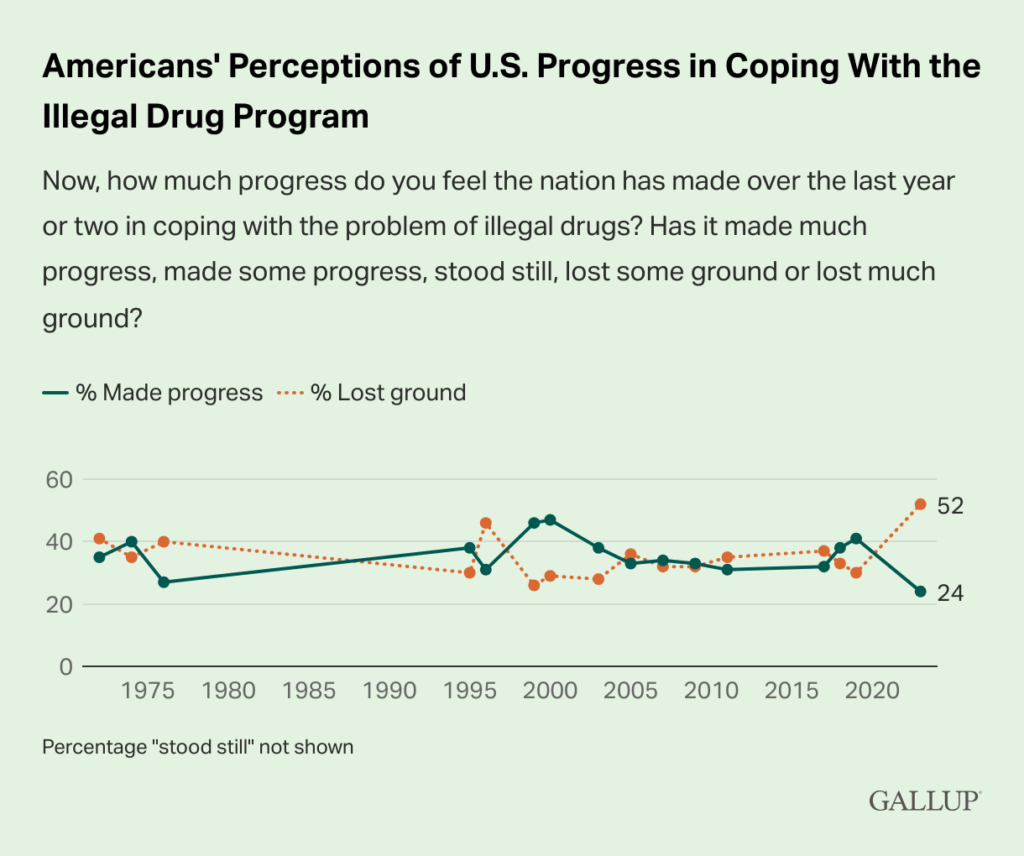
A majority of Americans now say that the U.S. is losing ground in the country’s “illegal drug problem,” according to a new Gallup poll. And at the same time, support for taking a fundamentally different approach to marijuana by enacting legalization has reached a record high.
The survey shows that 52 percent of respondents believe that the U.S. has “lost ground” in the drug war, while 24 percent said that the country has made progress. That’s a major reversal in public opinion compared to the last time Gallup asked Americans about the issue in 2019. At that time, a plurality (41 percent) was optimistic about progress, while 30 percent said the country was losing ground in combating illegal drugs.
Via Gallup.
That 22-point difference over the course of four years can likely be attributed to growing awareness and concern about the opioid overdose epidemic, which has compounded as fentanyl and other synthetic analogues have proliferated in the drug supply.
Part of the shift could also reflect a growing awareness that the decades-long focus on criminalization at the center of government drug strategies has not worked.
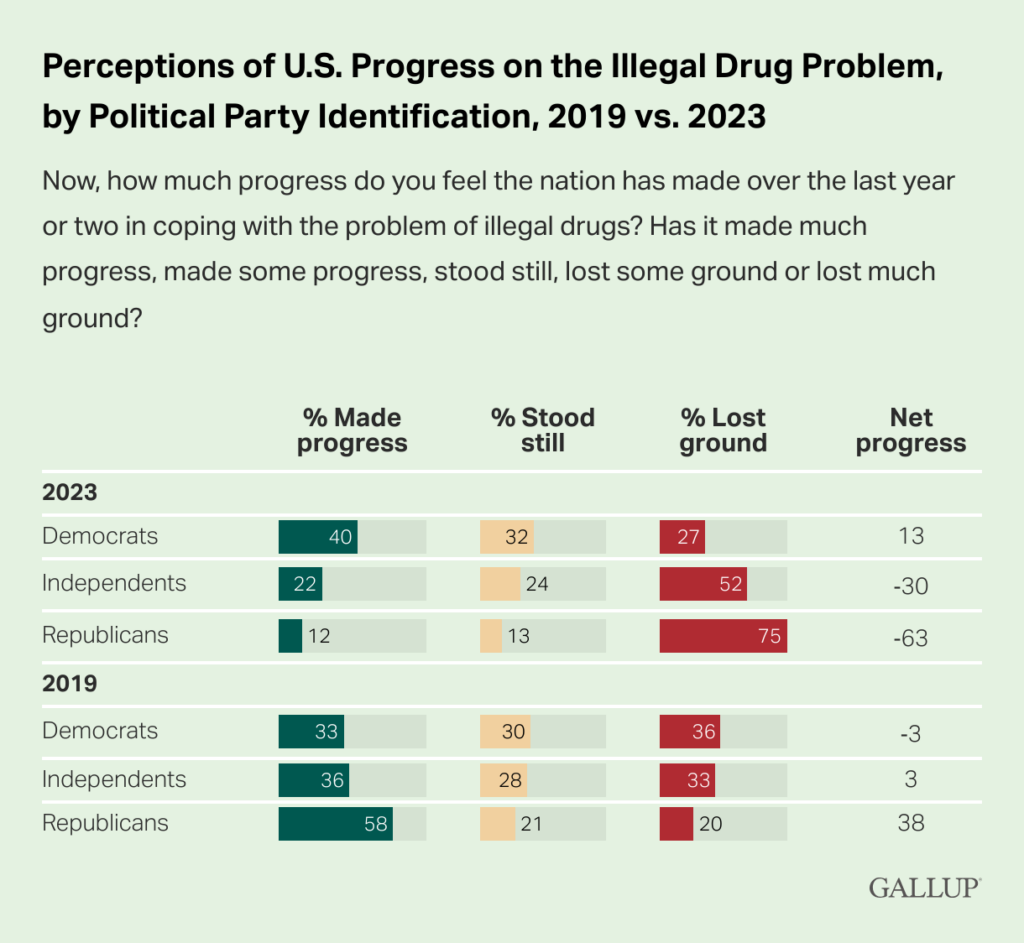
In any case, there are notable partisan divides in attitudes about progress in addressing drug issues, the new poll shows.
“Republicans are extremely negative about U.S. progress on illegal drugs, with 12 percent believing the U.S. is making progress and 75 percent losing ground,” Gallup’s analysis, published on Friday, says. “Independents are also decidedly pessimistic, with 22 percent believing progress is being made and 52 percent thinking the situation is getting worse.”
Via Gallup.
“In contrast, more Democrats think the situation is improving (40 percent) than worsening (27 percent),” it says. “These party differences underscore the importance of the match between a person’s partisanship and the incumbent president’s party in evaluating the drug situation.”
It’s possible that the media has partly fueled the sharply negative perspective on the issue, with certain sensationalized coverage feeding into a narrative that attempts to link rampant substance misuse with progressive policies and politicians, for example.
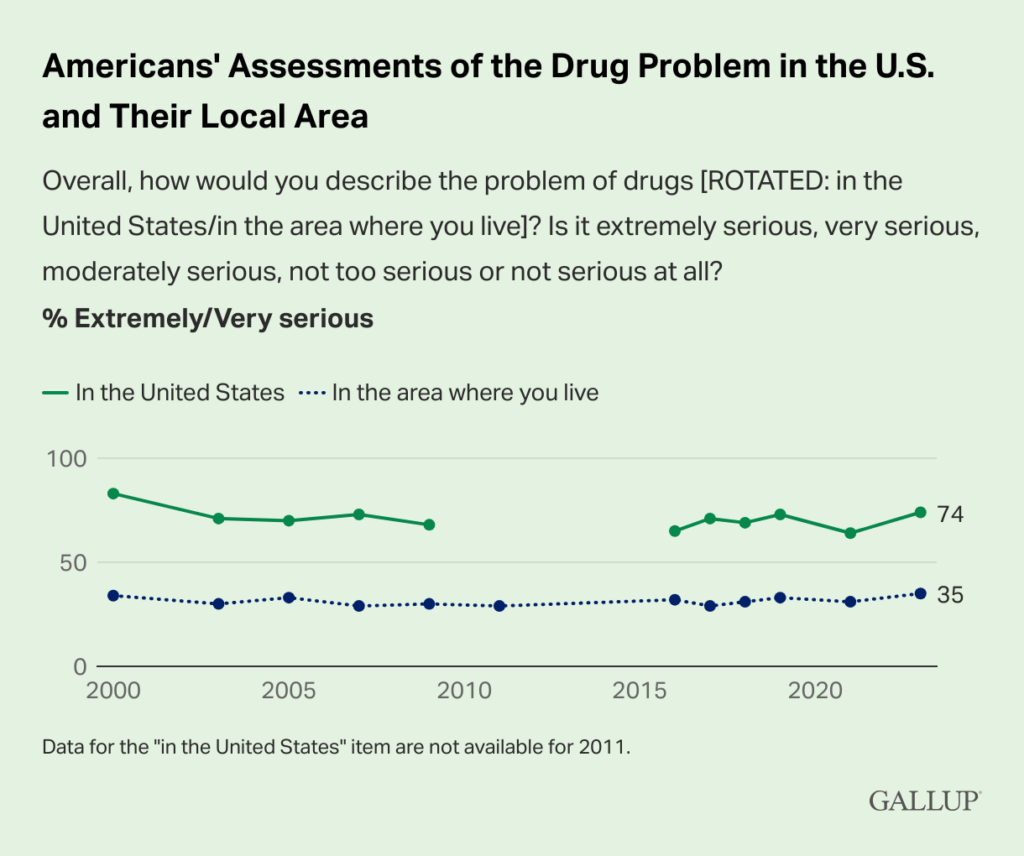
Another data point from Gallup seems to speak to that, showing that while nearly three in four Americans (74 percent) say that the country’s drug problem is either “very” or “extremely” serious, just 35 percent say the same about the situation in the area where they live.
Via Gallup.
Republicans and independents rate the situation in their local area similarly, with 40 percent of Republicans and 37 percent of independents saying the local drug problem is extremely or very serious,” Gallup said. “Democrats, at 27 percent, are less inclined to believe this.”
The polling firm didn’t define what constitutes a “drug problem” in the country, but the firm pointed out that the results come amid an “alarming spike in the number of U.S. adults succumbing to overdoses of opioids and other dangerous drugs.”
“Americans generally see little progress in addressing the illegal drug problem in the nation. The public has never been more pessimistic than they are today, at least in the years Gallup has collected data on the matter,” the analysis concludes. “Greater concern about U.S. progress could lead to drugs being a more significant campaign issue in next year’s presidential election than it has been in recent elections, which would put more pressure on candidates to devise plans for addressing the problem.”
Americans are the most pessimistic they have been about U.S. progress on the illegal drug problem. https://t.co/VuD58In42u
Indeed, the fentanyl overdose epidemic has been discussed at all three of the 2024 Republican presidential primary debates so far this year, with certain candidates like Florida Gov. Ron DeSantis (R) calling for a militarized response targeting drug traffickers. Others, such as former New Jersey Gov. Chris Christie (R), have emphasized the importance of addressing the demand side of the issue by focusing on preventative care and addiction treatment.
Marijuana, in contrast, hasn’t taken center stage so far in the 2024 conversation, which is perhaps a reflection of the growing bipartisan consensus around ending federal cannabis prohibition. Gallup released survey results last week that showed support for legalization at a record 70 percent nationally, and that includes 55 percent of Republicans.
Despite majority support for legalization among Republicans, however Gallup pointed out in a report earlier this year that a partisan divide has widened over the past two decades as Democrats have been even quicker to embrace the issue.
In terms of broader drug policy perspectives, a 2021 poll from the ACLU and Drug Policy Alliance (DPA) that was released ahead of the 50th anniversary of President Richard Nixon declaring the drug war found that two-thirds of American voters support decriminalizing simple possession of currently illegal substances.
A new survey of cannabis consumers with sleep issues found that most preferred to use marijuana instead of other sleep aids to help get to bed, reporting better outcomes the next morning and fewer side effects. Smoking joints or vaping products that contained THC, CBD and the terpene myrcene were especially popular.
Compared to using conventional sleep aids or no sleep aids at all, respondents reported that cannabis made them feel more refreshed, focused and better able to function the morning after, with fewer headaches and less nausea. But they also reported some side effects from marijuana use, including waking up feeling sleepy, anxious and irritable.
The study, conducted by a pair of psychology researchers at Washington State University (WSU), was published late last month in the journal Exploration of Medicine. Authors say they believe it’s the first research comparing cannabis to prescription sleep aids (PSAs) and over-the-counter (OTC) sleep aids.
“In general, the use of cannabis for sleep-related issues was perceived as more advantageous than over-the-counter medications or prescription sleeps aids,” Carrie Cuttler, a WSU professor and one of the study co-authors, said in a press release on Monday. “Unlike long-acting sedatives and alcohol, cannabis was not associated with a ‘hangover’ effect, although individuals reported some lingering effects such as sleepiness and changes in mood.”
More than 80% of the 1,255 cannabis users surveyed for the #WSU-led analysis reported no longer using over the counter or prescription sleep aids such as melatonin and benzodiazepines. https://t.co/PpMuA8CL4V
The WSU researchers surveyed 1,216 people for the study using the medical marijuana app Strainprint. Nearly two thirds (64.9 percent) of participants reported that they’d been suffering from sleep issues for at least five years, while nearly 70 percent said they’d been using cannabis to help with sleep for at least a year. A plurality of respondents (38 percent) said they’d been using marijuana for sleep for between one and three years.
Nearly 82 percent of the cannabis consumers said they do not currently use prescription or over the counter sleep medications, though more than half reported doing so in the past, indicating that they have some to see marijuana as a better option.
More than half the sample reported that they use cannabis every night to help fall asleep. Most respondents said they either smoke joints (46.1 percent), vape flower (42.6 percent) or use some form of cannabis oil (42.5 percent) before bed, although nearly a third said they use edibles and/or vape pens. Another 14.6 percent said they use cannabis in capsule form.
While inhaled forms of cannabis tend to be more popular among most consumers in general, authors said that those with sleep issues may prefer smoking and vaping “because of the short latency of onset with inhalation and the high percentage of respondents who indicated difficulty falling asleep.” They said they were surprised that edibles or capsules weren’t more popular “as these are longer lasting and as such may be more beneficial for maintaining sleep.”
In terms of product makeup, most respondents used high-THC products (60.0 percent), although 21.7 percent opted for a balanced THC–CBD blend. Asked about cannabinoids used for sleep, 78.8 percent said choose THC, 47.1 percent said CBD and 18.1 percent pointed to CBN.
As for terpenes, myrcene was the most popular (49.0 percent) followed by linalool (26.9 percent), limonene (24.7 percent) and beta caryophyllene (19.1 percent).
“One of the findings that surprised me was the fact that people are seeking the terpene myrcene in cannabis to assist with sleep,” Cuttler said in the WSU press release. “There is some evidence in the scientific literature to support that myrcene may help to promote sleep, so cannabis users seemed to have figured that out on their own.”
Asked to report how cannabis helps with their sleep, respondents said it relaxed their body (81.0 percent) and mind (83.0 percent), helped prevent interruptions in sleep (36.3 percent) and promoted a deeper (56.2 percent), longer (41.6 percent) sleep.
Of the 526 people who reported using prescription and OTC sleep aids in addition to marijuana, “significantly more reported that they feel more refreshed, more focused, and better able to function in the morning after using cannabis relative to OTC sleep aids, PSAs, or no sleep aids. Participants also reported fewer headaches and less nausea the morning after.”
“Participants reported feeling more refreshed, focused, better able to function, fewer headaches, and less nausea the morning after using cannabis for sleep than after using more conventional sleep aids or no sleep aids.”
Among those who used all three types of sleep aids, the report continues, “significantly more participants reported that they experience nausea, anxiety, and racing heart when using OTC sleep medications or PSAs compared to cannabis.”
Some side effects reported by participants are no surprise. Cannabis was more likely than other sleep aids, for example, to cause a dry mouth and red eyes. Other unintended consequences, however, were more noteworthy. For example, “significantly more participants endorsed feeling more sleepy, more anxious, and more irritable the morning after using cannabis relative to other sleep aids or no sleep aids,” the study says.
Those findings align with takeaways from past research that marijuana use can lead to longer sleep durations and fewer middle-of-the-night awakenings, but also more next-day fatigue.
Notably, researchers found that more than 60 percent of study participants reported getting six to eight hours of sleep when they used cannabis alone. Less than 20 percent, however, reported getting six to eight hours of sleep when using a prescription or OTC sleep aid, regardless of whether it was used in combination with marijuana.
“Overall the literature suggests that cannabis can be beneficial for some aspects of sleep,” authors wrote, “however, additional objective research is needed to determine which aspects of sleep are positively affected and which are negatively affected by cannabis.”
Despite marijuana’s potential side effects, researchers said they might be more tolerable for participants than side effects of other, more traditional sleep aids.
“These side effects may be less severe or impairing than the side effects they experience with other sleep aids,” the study says, “and therefore, contribute to the perception that cannabis is superior to more conventional sleep aids.”
Authors noted that their survey had a strong selection bias toward people who were already using cannabis because they perceive it to be helpful. “Not everyone is going to find that cannabis helps with their sleep,” Cuttler said in a statement, “and future research needs to employ more objective sleep measures to provide a more comprehensive understanding of the effects of cannabis for sleep.”
A 2019 study, meanwhile, found that people tended to purchase fewer OTC sleep medications when they have legal access to marijuana. In particular, authors of that study noted, “cannabis appears to compete favorably with OTC sleep aids, especially those containing diphenhydramine and doxylamine, which constitute 87.4% of the market for OTC sleep aids.”
Kentucky’s General Assembly Administrative Regulations Review Subcommittee has approved an emergency rule to regulate Delta-8 THC and other intoxicating hemp-derived cannabinoid products in the state. The rule aims to regulate products that are for adult use only and separate the products from those