
Major Drug Test Manufacturer Replaces Marijuana With Fentanyl In Updated Screening Panel Amid Legalization Movement
October 27, 2023
#KahliBuds #MMJ #CBD #THC
420GrowLife
via www.KahliBuds.com
Kyle Jaeger, KahliBuds, 420GrowLife
A top manufacturer of drug testing technology has announced a new screening panel that no longer detects marijuana and instead prioritizes fentanyl and other controlled substances in response to the “relentless change and the pressing need to adapt” as more states legalize cannabis.
Psychemedics said its updated Advanced 5-Panel Drug Screen “will transform the way organizations safeguard their workplaces, shifting the spotlight from marijuana to the paramount threat of fentanyl.”
The screening panel, which the company said has been approved by the Food and Drug Administration, is also being touted for increased accuracy in the detection of cocaine, opioids, PCP and amphetamines.
“As we grapple with an ongoing labor shortage and with marijuana’s legal landscape evolving in 49 states, it’s clear that the time for a change has come,” Psychemedics, which was founded in 1987 and pioneered the use of hair testing, said in a press release on Friday. “Traditional 5-panel drug tests, rooted in a four-decade-old paradigm, have failed to evolve in today’s drug market and are unable to detect the rising drug, fentanyl.”
Brian Hullinger, president and CEO at Psychemedics said that “few challenges in the workplace have undergone as dramatic a transformation as the shifting dynamics between marijuana and fentanyl.”
“Recognizing this shift, Psychemedics has developed the Advanced 5-Panel to bridge the gap,” he said.
An increasing number of legal cannabis states have enacted protections for workers who use marijuana off duty, preventing employers from taking adverse action over state-sanctioned activities.
—
Marijuana Moment is tracking more than 1,000 cannabis, psychedelics and drug policy bills in state legislatures and Congress this year. Patreon supporters pledging at least $25/month get access to our interactive maps, charts and hearing calendar so they don’t miss any developments.
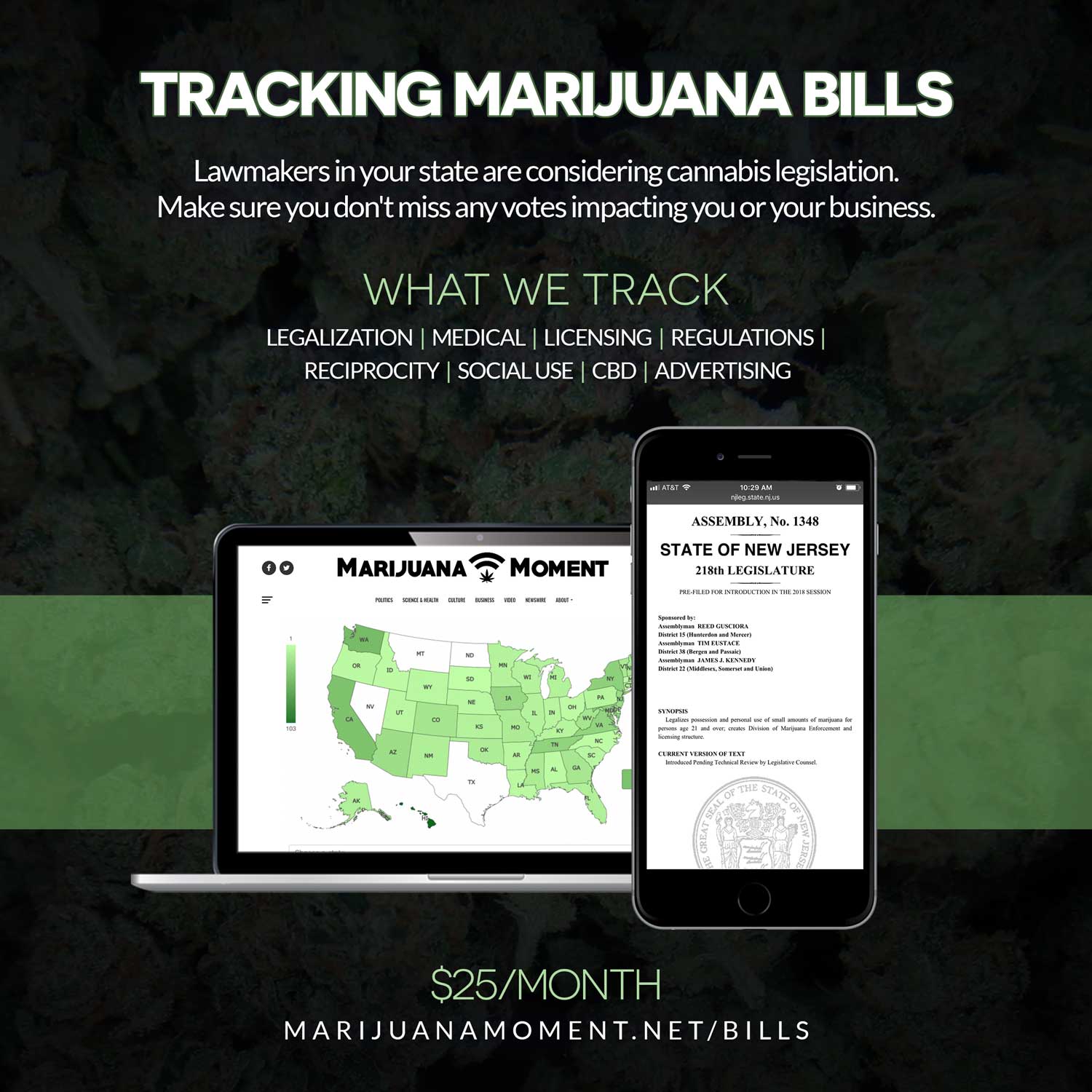
Learn more about our marijuana bill tracker and become a supporter on Patreon to get access.
—
For example, California’s governor recently approved a bill to prohibit employers from asking job applicants about prior marijuana use.
In Michigan, a policy took effect this month that ends pre-employment drug testing for marijuana for most government job applicants, while also giving people who’ve already been penalized over positive THC tests an opportunity to have the sanction retroactively rescinded.
In May, the governor of Washington State signed a bill into law that will protect workers from facing employment discrimination during the hiring process over their lawful use of marijuana.
That means Washington has joined Nevada in prohibiting discrimination against job applicants for testing positive for marijuana. New York also provides broader employment protections for adults who legally use cannabis during off-hours and away from work.
At the congressional level, the House Rules Committee has repeatedly blocked attempts by lawmakers to end the practice of drug testing federal job applicants for marijuana as part of large-scale spending bills this session.
Over in the Senate, however, members passed defense legislation in July that contains provisions to bar intelligence agencies like the CIA and NSA from denying security clearances to applicants solely due to their past marijuana use.
The House Oversight and Accountability Committee also passed a standalone bipartisan bill late last month that would prevent the denial of federal employment or security clearances based on a candidate’s past marijuana use.
At the same time, there are growing concerns about fentanyl in the drug supply. While experts have challenged claims about fentanyl-laced marijuana, there’s recognition that the potent opioid is being detected in drugs like heroin and cocaine.
Photo courtesy of Martin Alonso.
The post Major Drug Test Manufacturer Replaces Marijuana With Fentanyl In Updated Screening Panel Amid Legalization Movement appeared first on Marijuana Moment.
420GrowLife
via www.KahliBuds.com
Kyle Jaeger, KahliBuds, 420GrowLife
Wisconsin Republican Senator Says Medical Marijuana Progress Undermined By Democrat’s Broader Legalization Push
October 27, 2023
#KahliBuds #MMJ #CBD #THC
420GrowLife
via www.KahliBuds.com
Ben Adlin, KahliBuds, 420GrowLife
The Republican sponsor of a medical marijuana legalization bill in Wisconsin says a push by her Democratic colleague to legalize cannabis more broadly for recreational use is hampering efforts to convince other GOP members to pass the incremental reform focused on patient access.
Sen. Mary Felzkowski (R), a cancer survivor who supports a more limited medical marijuana system in the state, was speaking to PBS Wisconsin as part of a story on residents traveling to nearby Michigan to buy legal cannabis. Asked about the possibility of ending prohibition in her state, Felzkowski said that comprehensive changes may still be a ways off as she works to build support among fellow Republicans for her medical-focused reform.
She said a competing bill, a measure from Sen. Melissa Agard (D) that would legalize marijuana for both medical and adult use, isn’t helping.
“Melissa is very much in favor of this, and she can do, you know, whatever,” Felzkowski said. “But it does make it harder in our caucus, and I think a lot of our caucus members are looking at this going, you know, ‘We don’t want to be Illinois. We don’t want to be Minnesota.'”
In comments to Marijuana Moment on Thursday, Agard shot back that it’s the GOP legislative majority’s position—not her own—that’s holding back reform.
“Republicans have a near supermajority in both houses of the Wisconsin State Legislature. They are the only people standing in the way of cannabis reform—whether that be for medicinal purposes only or for full recreational use,” she said, adding that nearly 7 in 10 Wisconsin voters support legalizing cannabis for adult use. “Wisconsin Republicans are obstructing that.”
As for Felzkowski’s medical marijuana proposal, the Republican said support on her side of the aisle is growing. “For the last three sessions, I’ve been working on a bill around medical marijuana, and it’s slowly gaining,” she said. “Caucuses are very much more open to it.”
“I’m trying to help patients,” she continued. “I know people who have had very debilitating medical conditions, our veterans with PTSD, M.S., and I have a firsthand knowledge of what opioids do to you as a side effect.”
Felzkowski and Agard both spoke about the prospects of cannabis reform during a webinar hosted by the Wisconsin Policy Forum in April. Felzkowski said at the time that she’s personally “very, very focused on getting medical marijuana across the finish line the session.”
But she told Marijuana Moment that there would be a need to “compromise” on the legislation, which would likely prohibit smoking cannabis and limit the conditions that would make people eligible for medical marijuana.
The GOP-controlled legislature in May voted again to strip cannabis reform language from Gov. Tony Evers’s (D) budget request, which included measures on legalizing, taxing and regulating cannabis in the state.
As part of the budget request, Evers’s office estimated that the state would generate $44.4 million in “segregated tax revenue” from legal cannabis, as well as a $10.2 million increase in state general fund tax revenue, in fiscal year 2025 if the reform is enacted.
The governor also included adult-use and medical marijuana legalization in his 2021 budget, as well as decriminalization and medical cannabis in his 2019 proposal, but the conservative legislature has consistently blocked the reform.
While Republican leadership said earlier this year that negotiations over medical cannabis reform would be compromised if Evers moved forward with pushing for recreational legalization in his budget, the GOP caucus has privately met to discuss advancing medical marijuana legislation.
Assembly Speaker Robin Vos (R) didn’t provide details about the in-the-works proposals when he disclosed the meetings to the public, but he said that the goal is to draft something with bipartisan appeal that could be enacted later this year.
Top Democrats—including Agard—were skeptical of the plan.
“We’ve seen this story before—but actions speak louder than words,” she said at the time. “Session after session, the Speaker has come forward with empty promises but no tangible steps toward any form of legal cannabis Wisconsin.”
Wisconsin lawmakers are under pressure to provide some kind of regulated access to cannabis given the rapid regional policy shifts.
A report published in February found that 50 percent of Wisconsinites 21 and older live within 75 minutes of an out-of-state cannabis retailer, such as in Illinois or Michigan. That percentage stands to increase as legal stores open in neighboring Minnesota.
Wisconsin residents purchased more than $121 million worth of marijuana from legal retailers in neighboring Illinois in 2022, contributing about $36 million in tax revenue to the state, according to a recent legislative analysis requested by Agard.
Vos, the Assembly speaker, has said that trying to enact adult-use legalization through the budget could “poison the well” in the legislature, jeopardizing talks on medical cannabis. But the leader of the Senate has expressed that he thinks the more modest policy is feasible.
“Our caucus is getting pretty close on medical marijuana,” Senate Majority Leader Devin LeMahieu (R) said in January. “A lot of our members, who are maybe at a point where they can vote for it now, they just want to make sure it’s regulated well.”
Evers, the governor, said that he was encouraged by the Senate leader’s remarks about nearing consensus on medical marijuana, and he’s prepared to sign such legislation as long as it’s not “flawed” by including too many restrictions.
Evers didn’t bring up his legalization proposal in his budget speech this year, but he did stress in his inaugural address that the state needs to have a “meaningful conversation about treating marijuana much like we do alcohol.”
Former Assembly Majority Leader Jim Steineke (R) has said legalization is “likely” to happen at some point—but the legislature has so far failed to pass even more modest proposals like decriminalization or the legalization of medical cannabis.
Ahead of the November 2022 election, Evers met with college students and urged supporters to get engaged and vote, in part to ensure that the state advances marijuana legalization.
If Democrats had won enough seats, it could have also set them up to pass a resolution that the governor introduced to allow citizens to put initiatives on the ballot. Advocates expressed hope that the move could open the door to finally letting voters decide on marijuana legalization, but it’s unlikely that GOP lawmakers will go along with it.
Meanwhile, voters across the state have been making their voices heard on cannabis reform over the past several election cycles. Most recently, voters in three counties and five municipalities across the state approved non-binding advisory questions on their local ballots in support of legalization.
Republicans filed a limited medical cannabis bill last year—and it got a hearing on the unofficial marijuana holiday 4/20, but that came too late in the legislative session for lawmakers to actually vote on the measure.
Other GOP members have filed bills to more modestly decriminalize marijuana possession in the state, but none of those proposals have advanced.
As it stands, marijuana possession is punishable by a maximum $1,000 fine and up to six months in jail for a first offense. People convicted of a subsequent offense face a felony charge punishable by a maximum $10,000 fine and up to three and a half years in prison.
Photo courtesy of Philip Steffan.
The post Wisconsin Republican Senator Says Medical Marijuana Progress Undermined By Democrat’s Broader Legalization Push appeared first on Marijuana Moment.
420GrowLife
via www.KahliBuds.com
Ben Adlin, KahliBuds, 420GrowLife
Statement by David Cooper, Acting Executive Secretary of the Convention on Biological Diversity, on the occasion of the World Cities Day, 31 October 2023
October 27, 2023
#KahliBuds #MMJ #CBD #THC
420GrowLife
via www.KahliBuds.com
, KahliBuds, 420GrowLife
This article is a link to a PDF. Download the PDF: https://www.cbd.int/doc/speech/2023/sp-2023-10-31-cities-en.pdf
420GrowLife
via www.KahliBuds.com
, KahliBuds, 420GrowLife
Missouri NAACP Threatens Lawsuit To Stop Marijuana Social Equity Arrangements That ‘Defraud’ The State
October 27, 2023
#KahliBuds #MMJ #CBD #THC
420GrowLife
via www.KahliBuds.com
Marijuana Moment, KahliBuds, 420GrowLife
“The very people who were victimized by cannabis laws in the first place are yet again on the losing end of what appears to be a distinctly inappropriate power grab.”
By Rebecca Rivas, Missouri Independent
James Harnden has been a longtime activist for cannabis legalization, ever since he got slapped with a low-level felony possession charge for having an ounce of weed.
The 56-year-old Rockford, Illinois, resident says that charge has cost him job opportunities for 30 years.
Earlier this year, he saw an advertisement in the Craigslist “gigs” section posted by a Michigan cannabis real estate group called Canna Zoned MLS. It was looking for “partners who qualify as a social equity applicant” to participate in Illinois’s lottery to award cannabis business licenses that are, in part, meant to benefit people impacted by marijuana criminalization.
“I spent most of my life applying for jobs and not getting them,” Harnden said. “So I’m like, ‘Okay, so maybe one of these licenses will swing my way.’”
The Craigslist ad read: “If you are eligible and provide the required documentation, we will give you $2,000, just for helping us submit the lottery application! If we win the lottery and secure a license, we will give you an additional $20,000!”
Harnden says what he didn’t realize was that he signed a contract agreeing to hold 100 percent ownership interest on the application, but that he wouldn’t get revenue or profits from the business. After the business passed through all the state and municipal approvals, the contract stated that Harnden would be required to sell his share of the business for $1 to the group or be held in breach of contract.
The contract also authorized the group to enter Harnden’s information into lotteries for social equity cannabis licenses in other states—and that’s how Harden says he got paid $500 to be part of the lottery for Missouri’s microbusiness license program.
Harnden was eligible to apply in Missouri because of his marijuana charge, which is among seven eligibility categories that also includes living in census tracts with high poverty and unemployment rates. Canna Zoned’s Jeffrey Yatooma is listed as the “authorized agent” on the contract Harnden provided to The Independent, leaving a space for his signature at the bottom.
Yatooma secured two of the 16 social equity cannabis licenses—in Columbia and Arnold—issued earlier this month, according to information obtained by The Independent through a public records request. Those records show Yatooma is listed as the “designated contact” for 104 out of the 1,048 applications for dispensary licenses in Missouri’s lottery.
Yatooma’s group was not the only one using the strategy of flooding Missouri’s lottery with applications to obtain a dispensary license. An Arizona-based consulting firm is connected to more than 400 dispensary applicants, including six winners, and a Missouri firm is connected to more than 80 applicants and two winners. Both said their clients did not advertise or promise payment for submitting applications.
In at least three states holding lotteries for social equity cannabis licenses this year—Illinois, Maryland and Missouri—Yatooma’s group has offered to pay eligible people up to $2,000 to apply on their behalf and $20,000 more if they won.
While the Craigslist ads posted in Missouri can no longer be seen online, a screenshot of a similar ad posted by Canna Zoned in Illinois was included in a story by the Chicago Sun Times. Ads are currently up in Maryland, where the state’s social equity cannabis application opens on November 13.
Provided with a copy of Harnden’s agreement, Yatooma said his company, “never signed any agreements along the lines of the one you mentioned.”
He said that the agreement was part of “early business discussions.” Yatooma’s group made a similar argument earlier this year when efforts to secure licenses in Illinois faced criticism.
“The parties never moved forward with the referenced document, and the state subsequently provided guidance advising on how to structure partnerships,” Yatooma said in an email to The Independent. “In our experience with new laws, it is frequently important to begin business discussions and then be prepared to pivot—and finalize a partnership when new state guidance is announced.”
Yatooma also said he’s aware the microbusiness dispensary licenses “must continue to be majority owned by an individual who meets at least one of the eligibility qualifications” outlined in the constitution.
Voters approved the microbusiness program last November as a provision in the constitutional amendment that legalized recreational marijuana.
Nimrod Chapel, an attorney and president of the Missouri NAACP, reviewed the agreement signed by Harnden and provided to The Independent. He believes it “defrauds the state” because it gives the eligible applicants no voting or financial interest, in violation of the state’s constitution.
“The very people who were victimized by cannabis laws in the first place are yet again on the losing end of what appears to be a distinctly inappropriate power grab,” Chapel said.
Yatooma said he rejects “any allegations that we have defrauded the state.” Any final agreements with partners in Missouri, he said, “will absolutely comply with all state laws and regulations.”
Lisa Cox, spokeswoman for the Missouri Division of Cannabis Regulation, did not say whether or not the division had seen the agreements between Yatooma and the applicants.
However, she said such an agreement will be reviewed as part of the post-licensure verification process, where the division will “determine whether any microbusiness applications were false or misleading and to ensure all microbusiness licenses are majority owned by eligible applicants.”
That process will be completed by the end of the year, she said.
If the state takes no action to revoke Yatooma’s two licenses, Chapel said the Missouri NAACP would consider litigation to obtain a cease and desist order on the entire microbusiness program.
“If [the division] were to look at the agreements—that show the applications are not true—and they don’t take some action against these licenses,” Chapel said, “then I think that they would be totally complicit in a fraud.”
In response to the NAACP, Cox said the division will revoke the license if it “determines the applicant provided false or misleading information in the application.”
A pattern and practice
Simone Booker, a 52-year-old Chicago resident who works in tax preparation, remembers sitting down with an attorney for Canna Zoned, Amanda Kilroe, this spring at Starbucks to talk about a “great business opportunity.”
Kilroe’s number is currently listed on the Craigslist ads in Maryland, and she’s who responded when The Independent called the number.
However, Booker never saw a Craigslist ad. She was referred to Kilroe by a friend and never received $2,000 for applying.
“She’s a wonderful person,” Booker said of Kilroe. “I have met a few people [from Canna Zoned]. They are absolutely wonderful people. So that was the impression I got from them.”
Booker remembers asking Kilroe multiple questions about what her commission would be and what percent of the profits she would get. She said Kilroe assured her that she would be seen as a “social equity partner” and would get a share of the profits at every fiscal quarter.
Then after a year, Booker would agree to sell her shares of the company for an amount that “we would work out later,” she says Kilroe told her. They talked about how Booker could potentially make $200,000 before she sold her shares, and she could also choose to buy back into the business later if she wanted.
Booker says she now realizes she didn’t read the contract’s fine print closely because Kilroe seemed so trustworthy and professional.
Booker said Kilroe never mentioned the contract would force her to sell her shares for $1. And Kilroe’s description of the partnership, Booker said, was “completely different” than what she signed—that she agreed to receive “no disbursements” other than the $2,000 to apply and the $20,000.
More specifically, she’d get $10,000 after the municipality where the dispensary is located approved the location, and another $9,999 after the state approves the license and she transfers her ownership of the business.
Booker was shocked to find these provisions in her contract when asked about them by The Independent.
“I’m completely blessed that God didn’t approve this business,” Booker said. “I would have never signed the contract…not even for the $20,000 because $20,000 is not worth the millions that they’re going to make off of my name.”
Kilroe did not respond to The Independent’s requests for comment.
Booker fears for the other people who don’t realize what they signed. Having a tax background, she knows how to fill out the paperwork to ensure the group can’t use her name for an federal tax identification number (EIN) in the future.
The contract authorized the use of her Social Security number for an EIN, meaning she would be completely on the hook for tax liability of the business even though the contract claims otherwise, Chapel said. But other people don’t know how to do that, she said.
“Their name is going to be forever used for business, but they’re never going to profit,” she said.
Chapel said he’s never seen a contract like it.
“This agreement is wide ranging, not limited in time,” he said. “It’s not clear when—I guess at death—you would be released.”
It’s essentially agreeing to let the company use their “likeness” and name indefinitely, he said.
“How is this not literally buying at least a piece of a person?” he said.
A public warning
Kilroe told the Sun Times that Canna Zoned “didn’t end up moving forward” with any of the respondents to the ad, after the newspaper reached out to her about a similar agreement the group made with a gun-violence victim.
“We didn’t enter the game in Illinois,” Kilroe told the newspaper.
However, Yatooma’s group was behind at least 20 dispensary applications in Illinois under variations of the name “Chicago Retail LLC,” including Booker’s and Harnden’s, according to state business records. Chicago Retail LLC wasn’t on the state’s list of winners released on July 13, but it’s unclear if Yatooma came away with a license in Illinois.
Chris Slaby, spokesman for the Illinois Department of Financial and Professional Regulation, which oversees the social equity program, said the state’s cannabis law prohibits him from disclosing if Yatooma obtained a license.
The department was aware of posts like the Michigan group’s and issued a public warning in February to potential applicants about the dangers of these types of agreements, Slaby said in an email to The Independent.
Illinois conducted its lottery on July 13, and the department is currently assessing the winners’ eligibility. Slaby said it “may deny a license in the event it determines any false information was used to apply.”
Booker’s contract appeared to be identical to the one Harnden signed in Missouri.
Both stated that Yatooma’s group can use the applicants’ information in any of the other states lotteries for social equity cannabis licenses, and the group recently contacted Booker again about entering the next lottery in Illinois.
At the end of July, Harnden was notified that the group was entering his name in the Missouri lottery, which was conducted on August 28.
The Missouri contract is with a Michigan limited liability company called “Report Head LLC,” but Yatooma is the authorized agent listed on the contract.
Adolphus Pruitt, president of the St. Louis City NAACP chapter, also reviewed the agreement and said it establishes up a “modern-day indentured servitude.”
Pruitt agrees with Chapel that the Michigan group is defrauding the state, as well as putting the applicants in that position whether they know it or not. The St. Louis City NAACP chapter, he said, would support the state NAACP’s move to get a cease and desist order.
“It appears that it was never the intent for the ‘social equity partner’ to own, operate, nor benefit from the micro license as envisioned by the voters,” Pruitt said.
Of the 16 winners of dispensary licenses, only five appeared to have submitted just one application—meaning they didn’t make agreements with eligible people to apply on their behalf.
On October 2, the state issued 48 microbusiness licenses in total—six winners in each of Missouri’s eight congressional districts.
In each district, two were microbusiness dispensaries, and four were microbusiness wholesale facilities—where the owners can grow up to 250 plants.
According to records obtained by The Independent, the wholesale side—where there was 577 applicants total—did not appear to see the same kind of flooding strategy as for dispensaries, which had total of 1,048 applicants.
As far as finding multiple eligible applicants to apply on one person’s behalf, Yatooma’s operation was not the biggest. And he only applied in half of the state’s eight congressional districts—the 2nd, 4th, 5th and 6th.
A Phoenix cannabis consulting firm, Cannabis Business Advisors, is listed on 42 percent of the applications for dispensary licenses. And they are the designated contact for six of the 16 winning licenses.
In every congressional district where the firm’s clients won a dispensary license—including the 1st, 2nd, 4th, 5th 6th and 7th—its president, Maxime Kot, is the contact listed on between 40 percent and 60 percent of the applications in that district.
For example, in the 1st congressional district—which encompasses the City of St. Louis—Kot was listed as the contact person for 76 dispensary applications, making up 62 percent of the total submitted. In the 2nd district, it was 63 percent and in the 4th, 53 percent.
When asked how CB Advisors was able to find that many eligible people to apply, Sara Gullickson, founder and CEO of the firm, said: “As far as our intellectual property and how we submit applications—either lottery or merit based—obviously that’s the secret sauce of the company.”
However, after hearing about Yatooma’s strategy of posting Craigslist ads and paying applicants, she said that was “not our business model.”
“We’ve probably worked in 30 states and five countries,” Gullickson said. “I’ve been at this since I was 26 years old. I’m now 40 years old. I’ve just been around for a while.”
Gullickson has a stake in several cannabis licenses across the country that are minority- or women-owned. But in Missouri, she was acting as a consultant, she said, and wasn’t vying for a license herself.
When asked how many of the applicants are from out of state, she said that she didn’t want to disclose the information.
John Payne, founding partner at Amendment 2 Consultants, acted as campaign manager for both of the constitutional amendments to legalize medical and recreational marijuana in the state. He’s listed as the contact for 16 percent of the dispensary license applications statewide, including two winners—both in the 3rd district.
One of his winning clients applied with just one application, records show and Payne confirmed. The other had 68, which Payne said the person pooled with friends and associates to work together to apply and to get a license.
Like Gullickson, Payne said also he didn’t advertise or offer payment like Yatooma.
“It was almost all internal networks,” Payne said. “We knew a lot of people and those people knew a lot of people. So that’s how we kind of grew our client base.”
Payne said any questionable agreements made as part of the microbusiness license application process should come out in the next couple months, during the state’s post-licensure verification process.
“The department does a pretty thorough job of vetting these sorts of things,” Payne said. “They do ask for your operating agreements and contracts that you’ve signed, so that could be something that they look into.”
This story was first published in the Missouri Independent.
Photo courtesy of Mike Latimer.
The post Missouri NAACP Threatens Lawsuit To Stop Marijuana Social Equity Arrangements That ‘Defraud’ The State appeared first on Marijuana Moment.
420GrowLife
via www.KahliBuds.com
Marijuana Moment, KahliBuds, 420GrowLife


